
Zapata County VINE Coverage
The Zapata County Sheriff sends the public to Texas VINE through the county’s official page. That choice matters because the Sheriff does not publish its own current roster, release archive, or recent-release feed. VINE is therefore the county-endorsed public-facing route for a specific custody check or alert. The service receives data from participating agencies and can report a custody event. It does not become the Sheriff’s permanent booking ledger, and it cannot certify the legal reason that custody ended.
Coverage must be judged by the agency shown in the live selector and result. Zapata County operates the Zapata County Regional Jail and Zapata County Women’s Jail. A matching VINE record should identify the reporting agency or facility. The absence of a result can reflect spelling, timing, agency participation, or a custody move. It does not prove that the person was released. For durable proof, ask the correct jail for the release or transfer entry and compare it with the related court record.
The county-linked Texas VINE entry shows the official route used for Zapata County custody notifications.
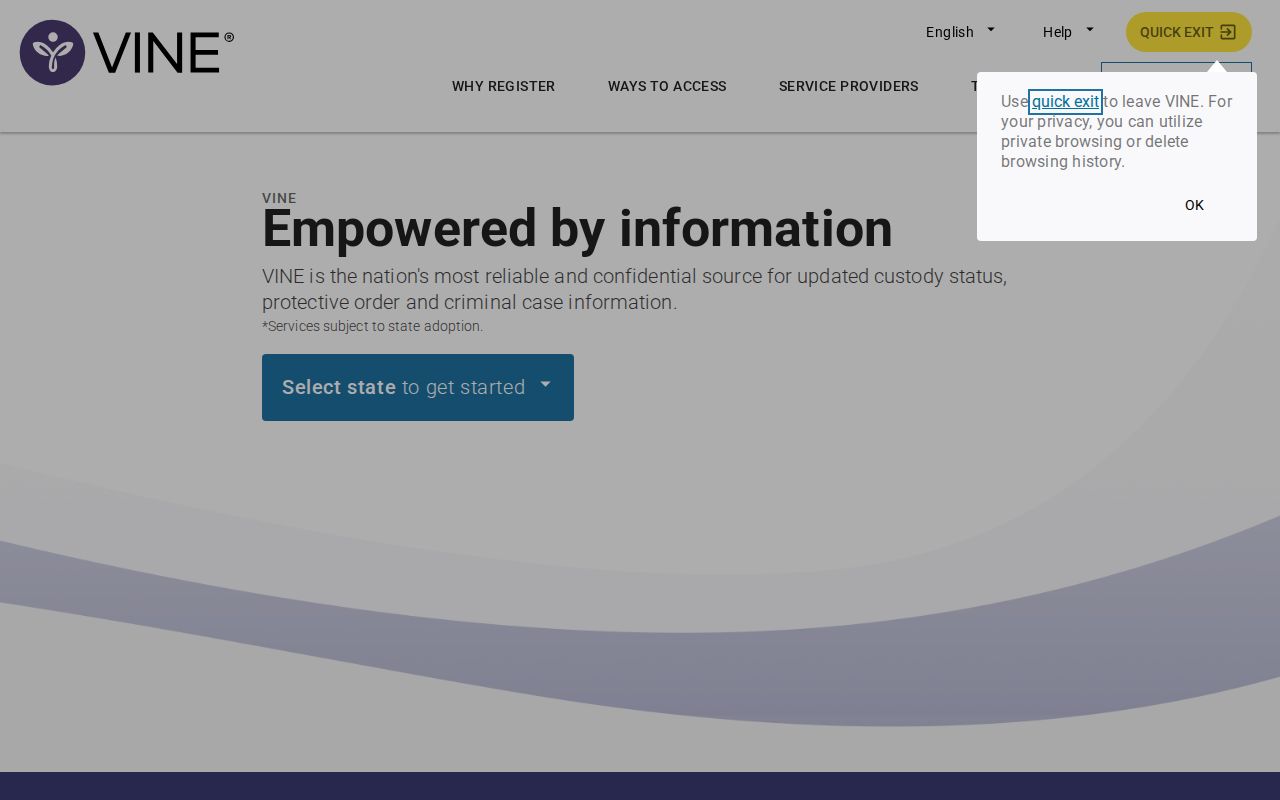
The linked entry establishes the county connection, while the live record and the jail supply the current facts for one person.
Search Zapata County VINE Records
Begin with enough detail to separate people who share a name. A surname and given name may produce several records. An offender or booking identifier is stronger when available. Compare the agency, facility, age or date of birth, booking identifier, and other non-sensitive details before treating a record as the right one. Never combine facts from two similar names.
- Open the Texas interface and choose the custody or offender search offered by the live service.
- Enter the surname and given name, or use an offender or booking identifier when the form permits it.
- Compare each match by agency, facility, age or birth date, and identifier before opening the record.
- Read the exact custody status, event date, reporting agency, and last-updated time. Note when the search was made.
- If no match appears, retry spelling and identifiers, then contact the jail. A blank search is not release proof.
The modern Texas VINELink search interface controls if its labels or available fields differ from older instructions.

The screen is the starting point. The matching agency record, rather than the state-selection page alone, supplies the reported custody event.
Note: Save the search time with the result because VINE data can trail the jail’s operational event.
Zapata County VINE Result Fields
A VINE result is most useful when each field is read as a limited fact. “In custody” describes the status reported by an agency. “Released” or “out of custody” reports a change, but it may not explain whether the person entered the community, transferred, or left under another authority. Event and update times can also differ. Record both rather than assuming they mark the same step.
| Field | What it establishes |
|---|---|
| Name and identifier | Helps distinguish the named record from similar matches. |
| Agency or facility | Shows which participating custodian supplied the event. |
| Custody status | States the agency-fed status, not the full legal history. |
| Event date | Dates the reported custody change when the interface provides it. |
| Last updated | Shows the age of the feed and warns of possible lag. |
| Notification options | Lists events and delivery methods currently offered for registration. |
A county jail release record answers a different question. It can connect the booking to a release time, release authority, release type, or receiving agency. A court docket may show the bond, dismissal, sentence, or order behind that event. VINE is strongest as notice. The booking and court records are stronger when written proof or legal context is needed.
Set Zapata County Release Alerts
Registration begins from the correct person’s record. The live service may offer release, transfer, escape, or a broad custody-change event. Delivery choices can include telephone, text, email, or account and app options. Select only the events actually shown. Contact methods change over time, so current screen prompts take priority.
- Open the verified record and select registration or notifications.
- Choose the offered event, such as release, transfer, or custody change, and select a delivery method.
- Enter the phone number, email address, or account destination and confirm it carefully.
- For automated calls, create the requested personal identification number. A four-digit PIN is common and acknowledges receipt so repeat calls stop.
- Complete any text or email link or code, save the confirmation, and reopen the registration to check the event types.
Use a PIN that is private and hard to guess. Do not share it. When an alert arrives, note its time and wording before calling the reporting agency. A transfer alert may be just as important as a release alert in Zapata County because county custody can end when another jail, TDCJ, federal authorities, or immigration authorities take custody.
Note: A notification marks an agency-reported change; it does not guarantee immediate display or prove a return to the community.
Two Texas Release Alert Layers
Texas has a distinctive two-layer notification structure. The Zapata County Sheriff points county-custody users to VINE. TDCJ operates the Integrated Victim Services System, known as IVSS, for eligible notifications involving people in the Correctional Institutions Division or under Parole Division supervision. IVSS may use email, letter, text, or a combination for eligible registrants. TDCJ Victim Services can be reached at 800-848-4284 or victim.svc@tdcj.texas.gov.
The custody type decides which layer matters. A recent arrest at either Zapata County jail belongs first in the county VINE and jail-record path. A person transferred from a Zapata jail into TDCJ did not leave custody for the community. Once state-prison custody begins, TDCJ status, release processing, and IVSS are the relevant state channels. County VINE should not be treated as the authoritative TDCJ discharge record.
Post-conviction notice also differs from a public locator. IVSS eligibility and registration rules govern its notices, while TDCJ’s current-inmate search reports only people currently incarcerated in a TDCJ facility. A former prisoner’s incarceration history is requested from TDCJ through its official information channels. These systems may describe parts of the same custody path, but none should be stretched beyond its stated scope.
Confirm Zapata County Release Events
A result that says released or out of custody requires one more question: released to where? Use the official Zapata County jail directory, then call the Regional Jail at 956-765-8615 or the Women’s Jail at 956-765-9981. Give the full name, a suitable identifier, and the approximate booking date. Ask when Zapata County custody ended, whether the event was community release or transfer, and which agency received the person if it was a transfer.
Then request the booking or release sheet if written evidence is needed. Useful requested items include the booking number, booking date, charge or cause number, release date and time, release type or authority, and receiving agency. The court record adds legal context. Misdemeanor matters begin with the County Clerk and Constitutional County Court; felony matters begin with the District Clerk and 49th District Court.
For a released-person search that reaches beyond a VINE alert, the Zapata County released inmate search path explains how jail, court, state, federal, and immigration records fit together.
Zapata Release Systems Beyond VINE
Federal custody is outside VINE. Search the Bureau of Prisons locator for a person held or formerly held in the federal prison system. A “Released” or “Not in BOP custody” result still needs context because it can describe more than a return to the community. A U.S. Marshals pretrial detainee may not appear in BOP at all. Use the federal court docket, counsel, detention facility, or proper federal inquiry for that stage.
Immigration detention follows another route. ICE’s locator accepts an A-number with country of birth or biographical details. Recent bookings and some categories may not appear at once. When an immigration detainer was involved, confirm the Zapata transfer record and then check ICE or the proper Enforcement and Removal Operations office. Never treat release from criminal custody as proof that an immigration hold ended.
The Texas Public Sex Offender Registry is also separate. It covers only people subject to registration law. It is not a broad released-inmate database, and a registry record cannot prove when or why a Zapata jail episode ended. Use it only for its defined registration purpose. VINE remains the custody-notice route for a participating jail record.
Zapata VINE Check Limits
VINE reports agency-fed events, and those events can lag. A recent booking may not be visible yet. A release alert can arrive after physical processing. The service does not guarantee that every Zapata booking, federal move, immigration transfer, or historic custody episode will remain searchable. A miss may come from a name variant, an identifier error, a delayed feed, or a system boundary.
Strong verification uses several records in order. Start with the matching VINE event. Confirm it with the jail that held the person. Obtain the Sheriff’s release or transfer entry for a lasting record, then use the court file to explain the authority. If another agency received the person, continue with that agency. For a state prisoner, use TDCJ’s current search while custody is active and its information-request or parole channels after release processing.
- Custody change
- An agency-reported event such as release, transfer, escape, or another status move.
- Transfer
- The end of one agency’s custody because another custodian receives the person.
- Discharge
- The completion of the governing sentence or supervision obligation, not merely departure from one jail.
That sequence prevents the most common error: treating a missing name or fast alert as complete proof that a person returned to the community. The originating record remains the final check.