
No Zapata 24-Hour Release Feed
No official Zapata County jail roster, daily released-person feed, or release archive was found on the Sheriff page or in county navigation. The county therefore supplies no public 24-hour URL, filter, field list, refresh schedule, photograph policy, or display-retention rule. The Sheriff points people to Texas VINE for custody information. VINE is useful for a named-person status check or alert, but it is not a public list of everyone whose county custody ended today.
This absence changes the first step. Do not substitute an unofficial recent-arrest page or assume that a blank result proves release. A name may be missing because identifiers differ, data have not refreshed, the person was sent to another agency, or the service does not retain the old event. The reliable same-day question is whether the jail closed that custody episode and, if so, how. The jail's response and its booking-out record are stronger than an inference from silence.
The official Sheriff source shows the county's jail role and its VINE direction. It does not display recent-release navigation, which is why the official fallback begins with a named search and a call.
The matching screenshot records the Zapata County Sheriff source configuration:
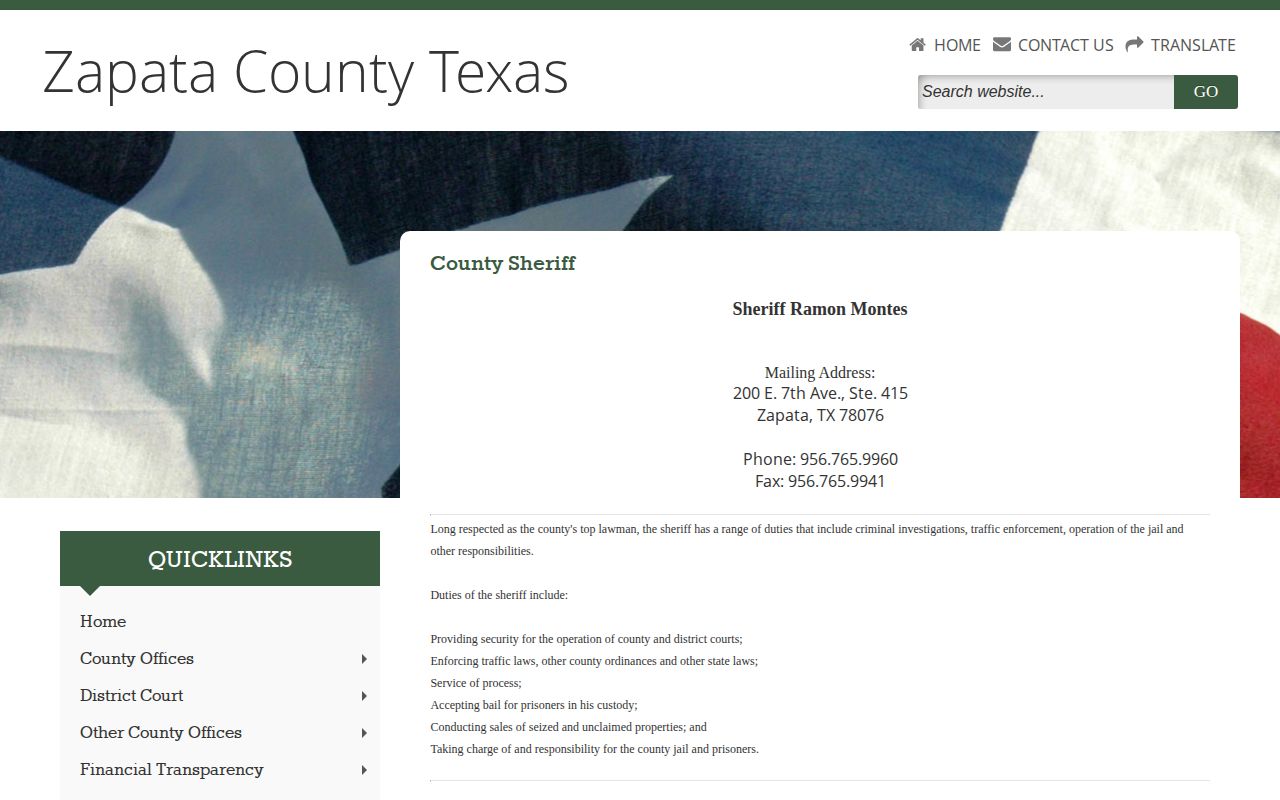
The image supports the limited claim that VINE is offered while no public daily release feed appears on the Sheriff page.
Check Zapata County Releases Today
Begin with the present time and the correct local facility. Zapata County operates the Regional Jail and the Women's Jail, and the county directory lists separate phone numbers. A caller should not guess which building handled a booking. Give the full name, an approximate booking date, and another suitable identifier when asked. Keep the inquiry narrow enough for staff to locate the right custody episode.
- Record the search date and time in Central Time so the intended 24-hour period is clear.
- Search Texas VINE for the named person and Zapata County agency, while allowing for an agency-data lag.
- Call the Regional Jail at 956-765-8615 or the Women's Jail at 956-765-9981, as appropriate.
- Ask when county custody ended, what type of event occurred, and whether another agency received the person.
- Check the matching court case for a bond, dismissal, order, judgment, jail credit, or other legal event.
- Request the booking and release sheet when written, episode-specific confirmation is needed.
The Zapata County directory is the official source for both jail listings and direct numbers. If the facility confirms release but timing is still unclear, ask for the exact release timestamp rather than a broad yes-or-no answer. For a search centered on one known person instead of a daily interval, the Zapata County released-inmate search path explains how custody systems split.
Note: Save the time of each VINE search and jail call because a same-day agency feed can change after the first check.
Zapata 24-Hour Release Record Fields
There is no published Zapata County 24-hour field set. The terms below are fields to request from the Sheriff, not a claim about labels on an unseen county screen. Ask for enough detail to connect one booking with the event that ended it. The release type and receiving agency matter as much as the time because they separate a return to the community from a transfer.
| Requested field | What it helps confirm |
|---|---|
| Name and identifying details | Distinguishes people with the same or similar names. |
| Booking number and booking time | Ties the answer to one Zapata County custody episode. |
| Charge and cause number | Connects the jail event to the correct court case. |
| Release or transfer timestamp | Shows whether custody ended within the stated daily window. |
| Release authority or type | Identifies bond, time served, court order, dismissal, sentence completion, or another stated basis. |
| Receiving agency or destination | Shows whether the person moved to TDCJ, another jail, federal authority, or immigration custody. |
A release label must be read narrowly. Bond means the person left confinement while the case may remain open. Time served does not necessarily mean dismissal. Transfer means Zapata County custody ended, but it does not mean the person went free. A release sheet answers the physical-custody question; the court file supplies the legal context.
Zapata Release Alerts and Proof
Texas VINE and the Sheriff record do different work. VINE can show an agency-fed custody event and can send a notice for a named person. That makes it practical for a release that may have occurred today. It is not a certified historical booking ledger, and an event can lag. A direct jail answer provides a current check, while the written booking and release sheet gives durable proof tied to the booking.
Court records add the reason behind the physical event. Class A and B misdemeanor matters generally begin with the Zapata County Clerk and Constitutional County Court. Felony matters generally begin with the Zapata District Clerk and 49th District Court. A bond entry, dismissal, judgment, or order may explain why release processing started, yet physical departure can occur after the court event. The jail timestamp should resolve when Zapata County custody actually ended.
These sources form a useful evidence order: jail release entry, court authority, VINE custody-change event, and receiving-agency confirmation when a transfer occurred. None should be stretched beyond what it says.
Zapata Release or Transfer
A person still held by either Zapata County jail remains in county custody. A person whose local custody episode ended may have returned to the community, but several other outcomes are possible. The Sheriff may have transferred the person to TDCJ, another county, the U.S. Marshals, the Federal Bureau of Prisons, or immigration authorities. Medical movement also does not establish community release.
- Community release
- The person leaves confinement through bond, time served, sentence completion, dismissal, or another lawful release authority, subject to any remaining conditions.
- Transfer
- One agency ends custody because another agency receives the person.
- Parole
- A state prisoner leaves physical confinement under conditions and TDCJ supervision.
- Discharge
- An agency's custodial or supervisory duty ends, though the court judgment may remain.
If a caller hears that the person is “gone,” the next question should be direct: released to the community or transferred, and to whom? That wording is especially important in Zapata County because local records document contract custody in past years. Historical contract use does not prove a current agreement, but it makes agency-to-agency movement a real issue to check.
Note: A live custody system is built to show who is held now, while a release record preserves how one prior episode ended.
Getting Home After Zapata Release
Transportation requires its own confirmation after a Zapata County release. The county advertises Zapata Express weekday bus service to Laredo, and regional planning material documents local demand-response transportation. Neither source establishes a jail-door stop, a ride furnished by the Sheriff, or guaranteed eligibility for a person just released. A planned trip should be based on direct confirmation, not on the existence of a bus service alone.
Call 956-765-9920 before relying on the service. Confirm the physical jail exit, the current schedule, any reservation or rider-eligibility rule, and the actual pickup point. Release processing can finish at a time that does not line up with transit. A family member arranging a pickup should also verify which jail will discharge the person because the Regional Jail and Women's Jail have different locations.
The Zapata County homepage is the source for the advertised Zapata Express link. It supports a possible onward option, not a promise of transport at release.
Why Zapata Releases Stay Unlisted
Zapata County's unusual data point is the lack of both a public custody roster and a recent-release archive on the official Sheriff page. There is no known 24-hour retention rule because no county list was found. There is also no published refresh lag. A reader therefore cannot count back one day on an official screen or assume that every release is visible for a set span.
VINE narrows the gap for a named person, but it does not turn into a bulk daily report. A just-completed event may not display at once. An old event may not remain available. Name matching can also affect a result. The answer must be rebuilt from the time of inquiry, a jail response, the court event, and the written release or transfer entry. This is ANGLE E's core Zapata County distinction, and it prevents an absent name from being mislabeled as freedom.
For a broader interval that can absorb a late check, use the Zapata County 72-Hour Releases process. It still requires records rather than a live county feed, but its date-range request is designed for several days.
Request Zapata Daily Release Records
A daily request should define the interval with dates, timestamps, and Central Time. Ask for records showing people whose Zapata County jail custody ended between 12:00 a.m. and 11:59 p.m. on the chosen date, including the event time, type, and any receiving agency. That wording captures both releases and transfers without calling every exit a community release. If the Sheriff does not keep a prepared daily report, narrow the request to named people or ask for jail-register entries within the same interval.
Texas Government Code Chapter 552 provides the Public Information Act process. Direct the written request to the Sheriff at 200 E. 7th Avenue, Suite 415, Zapata, TX 78076. The county does not publish a dedicated Sheriff request form, email, online portal, fee chart, or office hours. Call 956-765-9960 first to confirm the accepted written-delivery method. Request electronic copies, accept lawful redaction, and ask for an itemized estimate before work exceeds a stated cost limit.
State retention rules provide a later fallback. Local Schedule PS4200-06 describes the county jail register as permanent and includes the release or transfer date among its basic fields. PS4200-10 sets a release-or-transfer-plus-two-years minimum for prisoner incarceration records such as booking-in and booking-out forms and release orders. Those are retention floors, not promises that every requested detail must be disclosed.
Note: Ask for the permanent jail-register entry first when the event is old, then seek detailed release paperwork that may still remain.