
Zapata County Release Date Meanings
Several dates can appear in a custody or sentence record. The maximum expiration date is the calculated endpoint of the sentence under the governing judgment, credit, and legal rules. A parole eligibility date marks when the person may be considered for parole. It is not a release order. TDCJ’s projected release date is Classification and Records’ current estimate under the applicable pathway. A scheduled date and location may appear only after favorable release processing and an audit.
A pretrial person at the Zapata County Regional Jail or Zapata County Women’s Jail normally has no sentence-based projection. Bond can permit release while the case stays open. A court can alter bond, issue or recall a capias, dismiss a charge, or enter another order. A detainer can keep a person in custody even when one case would allow release. The jail’s booking-out record confirms the operational event, while the court file explains the legal authority.
- Projected release date
- TDCJ’s current calculation of when a prisoner may leave under the governing release path.
- Parole eligibility
- The date consideration may begin, not a right or promise of release.
- Mandatory supervision
- A statutory release mechanism involving calendar time, good time, eligibility rules, and sometimes Board review.
- Discharge
- Completion of the sentence or supervision obligation, distinct from release on parole.
Locate Zapata County Release Dates
Start with the custody system. A recent Zapata arrest calls for the jail and court path. A sentence in a TDCJ prison calls for state records. A federal case belongs in federal channels, while an immigration detainer may lead to ICE custody. Moving from one system to another is a transfer, not proof that the person returned to the community.
- Identify whether the person is pretrial, serving a county sentence, in TDCJ, or held under another authority.
- For county custody, call the correct Zapata jail and ask whether a credited date exists. Obtain the judgment from the proper clerk.
- For a current state prisoner, search TDCJ by exact surname and given name or initial, TDCJ number, or State Identification number.
- Open the state detail record and separate current location, parole review, projected release, and any scheduled date or location.
- For a former TDCJ prisoner, request incarceration history through the official email channel. Confirm actual release with the responsible unit or records office.
The TDCJ Online Inmate Search is limited to people currently incarcerated in a TDCJ facility. It updates on working days, and its data are at least twenty-four hours old. A blank result does not establish release. It can reflect the current-only scope, timing, or an identifier problem.
Note: Use optional sex and race filters only to distinguish matches; do not broaden a weak name match into a firm identity.
Zapata County Jail Date Checks
County-jail time is not calculated under TDCJ prison formulas. For a sentenced misdemeanor or other local jail term, the judgment, jail credit, and any lawful local or statutory credit govern. No published Zapata County good-time policy or weekend and holiday release rule was found. Applying a statewide prison credit chart to either Zapata County jail would create a false date.
Use the official Zapata County jail directory, then call the Regional Jail at 956-765-8615 or the Women’s Jail at 956-765-9981. Ask which building holds the person, whether the person is pretrial or serving a sentence, and whether staff can confirm a credited release date. If release has already occurred, request the booking-out entry with date, time, authority, type, and transfer destination when applicable. Ask for the calculation or responsive record when the date is disputed.
Court level also matters. Class A and B misdemeanor records begin with the County Clerk and Constitutional County Court. Felony judgments and proceedings begin with the District Clerk and 49th District Court. A docket event may precede physical release because the jail still must process the order and clear other holds. Pair the court document with the jail timestamp.
TDCJ Projected Release Records
TDCJ defines a projected release date as a Classification and Records calculation of when a prisoner is expected to leave if not paroled earlier. It is not a historical released-offender field guaranteed to remain in the public locator. The online search covers current prisoners. A person who no longer appears may have been released, but that absence can also reflect the system’s scope or data timing.
The official TDCJ definitions page shows the state meaning of a projected release date.
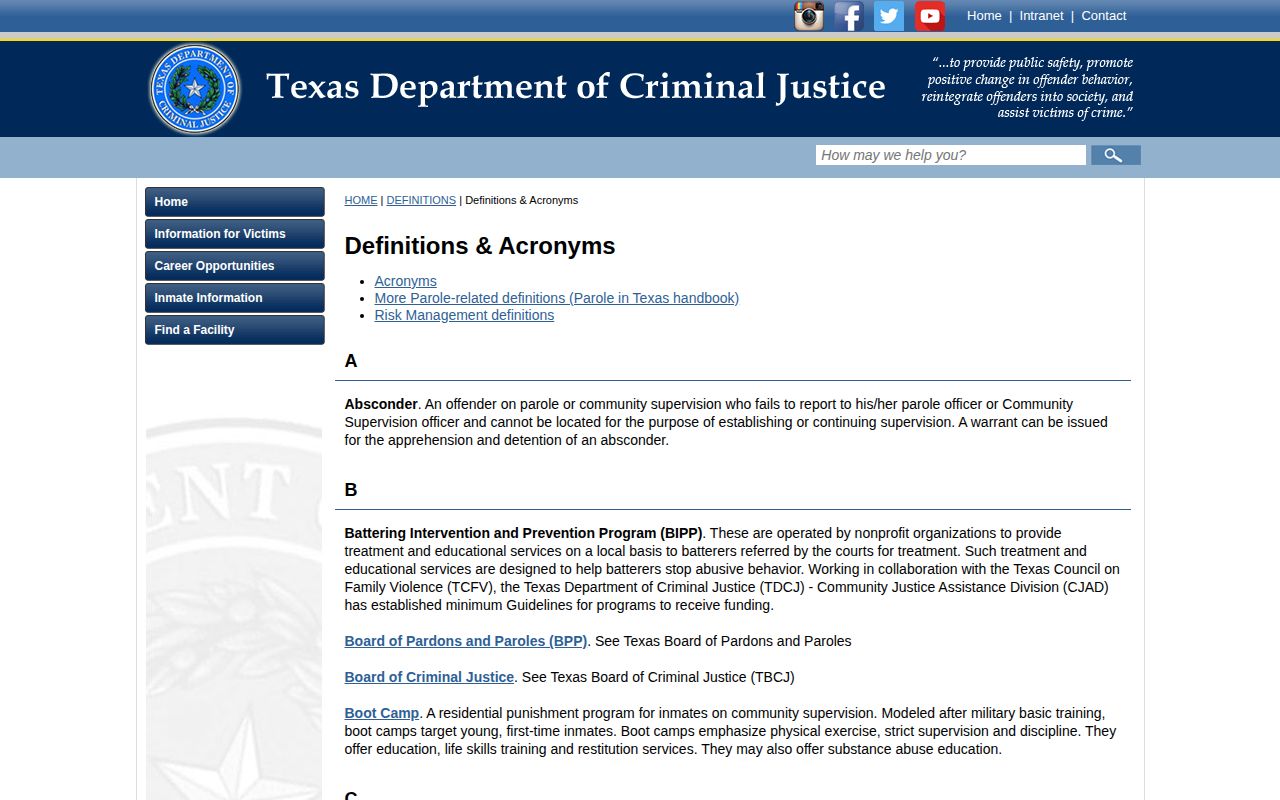
The definition separates TDCJ’s estimate from parole eligibility, a later schedule, and the completed release event.
For older mandatory-supervision-eligible cases before September 1, 1996, TDCJ generally describes the projection as the point when calendar time plus good time equals the sentence. For eligible later offenses, that equality does not finish the analysis because Board approval is required. A denial can push the displayed projection to maximum expiration. A later approval can move it earlier. If mandatory supervision is unavailable, the projection generally points to maximum expiration unless parole occurs first.
Zapata County Good Time and Release
Texas Government Code Chapter 498 controls state good-conduct-time classifications and forfeiture. In broad current terms, eligible trusty and Class I prisoners can accrue twenty days for each thirty days actually served, with some trusty classifications eligible for added credit. Class II can accrue ten days per thirty. Class III prisoners and people already on parole or mandatory supervision do not accrue credit as active prisoners.
Good time is a privilege, not a vested right. Section 498.003 states that it applies to eligibility for parole or mandatory supervision and does not otherwise shorten the sentence term. Classification and disciplinary history affect accrual. Section 498.004 permits forfeiture. A simple calculator cannot know the valid classification, forfeiture or restoration history, offense date, exclusions, sentence structure, or Board action in a specific case.
Mandatory supervision is governed with Government Code Chapter 508. Sections 508.147 and 508.149 address the calendar-plus-good-time mechanism, excluded offenses, and Board review for later offenses. The Board may deny release if the statutory findings are made. TDCJ’s official date remains the controlling calculation.
Note: Good time can affect a release pathway without changing the stated length of the sentence imposed by the court.
No Texas 85 Percent Rule
Texas does not impose a blanket rule that all prisoners serve about eighty-five percent of a sentence. That shorthand comes from other legal and funding contexts. It is unsafe for a Zapata County release projection because Texas uses offense-specific, offense-date-specific, and sentence-specific rules.
For specified serious offenses and affirmative deadly-weapon cases, Government Code Section 508.145(d) generally sets parole eligibility at the lesser of one-half of the sentence or thirty calendar years. Good time does not count toward that threshold, and a two-calendar-year floor generally applies. Other offenses, life terms, capital cases, child and trafficking offenses, stacked sentences, and differing offense dates can follow distinct rules. Eligibility only opens consideration. It does not guarantee release.
“3g offense” is legacy language from former Code of Criminal Procedure Article 42.12, Section 3g. Current Article 42A.054 holds the limitation-on-judge-ordered-community-supervision list, while Section 508.145 supplies parole-eligibility rules. The categories are often blurred in casual use, but neither label supplies a reliable release calculator. The Board’s current Parole in Texas eligibility tables and TDCJ’s calculation must be used for the actual case.
Why Zapata Release Dates Change
A projected date can move even when the judgment itself has not changed. Some changes come from prison conduct or classification. Others come from a new legal event, another custodian’s hold, a Board decision, or correction of credit. Administrative processing also separates an approved release path from a firm pickup date.
| Factor | Possible effect on the date |
|---|---|
| Jail-credit correction | A corrected amount of prior custody credit can alter the calculation. |
| Good-time status | Classification, forfeiture, or restoration can change applicable credit. |
| Board decision | Approval, denial, or later review can move the release pathway. |
| Program requirement | A required program can delay release processing until it is completed. |
| Detainer or new sentence | Another case, consecutive term, or receiving agency can prevent community release. |
| Court action | An amended judgment, order, or sentence issue can require recalculation. |
| Certificate audit | Classification and Records must verify the release certificate and calculation. |
| Data lag | The public screen may trail the operational decision or event. |
After a release certificate reaches Classification and Records, TDCJ says the audit and calculation generally take fourteen to twenty-one business days. A scheduled release date and location may then appear. Even that schedule can change without notice, including on the planned day. Call the unit before making a trip.
Zapata State Release History Requests
A former TDCJ prisoner may vanish from the current-only search. TDCJ’s official email information request is the stronger fallback. Put the person’s full name in the subject. Include the seven-digit TDCJ number when known. If it is unknown, supply the exact date of birth or an approximate age with the county of conviction. TDCJ says the response can include the TDCJ number, location, conviction offense, county and court, incarceration history, current incarceration, and projected release date without a fee.
The TDCJ offender information request page documents that historical and projected-date route.
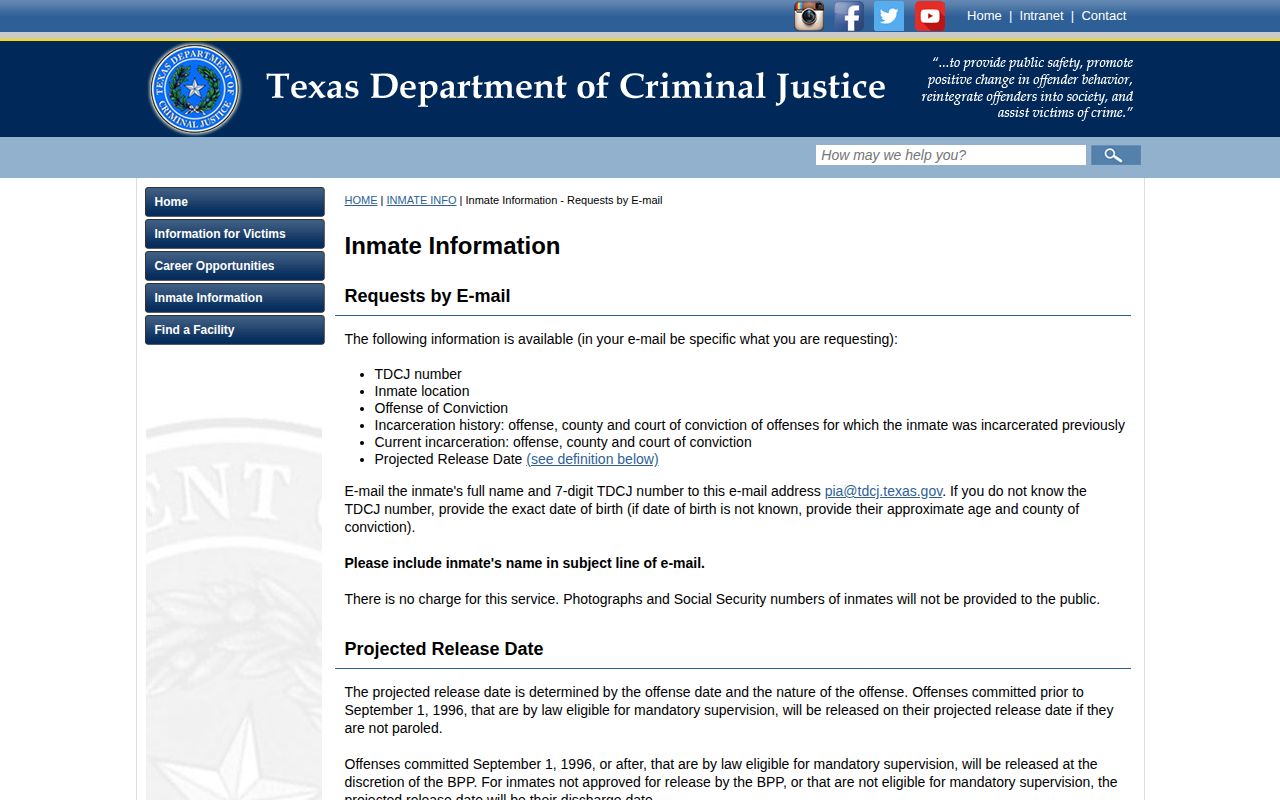
The email channel is valuable after the person no longer appears in the live locator, but it does not provide photographs or Social Security numbers.
Telephone routes can help during active processing. Before a Board vote, the status number is 844-512-0461. After a vote and during release processing, use 512-406-5202. General locator numbers are 936-295-6371 and 800-535-0283. TDCJ requires a TDCJ or SID number, or an exact date of birth when no number is known.
Confirm Zapata County Actual Release
Do not stop at an eligibility date, a favorable Board vote, or a projected date. A favorable vote begins more processing. Classification and Records must audit the certificate, calculate the schedule, and clear holds and requirements. A scheduled location describes planned release processing, not a completed departure.
For a state prisoner, call the unit before travel and later obtain TDCJ incarceration history. If parole or mandatory supervision follows release, confirm the assigned office through the Parole Division. Zapata County maps to the Laredo District Parole Office, but assignment can depend on the approved plan. Probation is different. It is court-ordered community supervision and is handled locally through the Webb County CSCD Zapata Office.
For a county detainee, the Sheriff’s release or transfer entry and the court record answer the final question. A VINE alert can provide fast notice, and the Zapata County VINE inmate check explains registration. The alert still needs agency confirmation. If another custodian received the person, continue the search there instead of labeling the event community release.
The safest chain is short: identify custody, read the correct official date, ask what can change it, and confirm physical departure after it occurs. That keeps a Zapata County projection from being mistaken for a promise.