
Zapata County Released Inmate Records
“Released” describes the end of one custody episode, not one single outcome. A person may leave the Zapata County Regional Jail or Zapata County Women’s Jail after posting bond, receiving a dismissal, receiving credit for time served, or finishing a county sentence. A person may also leave the jail in the custody of the Texas Department of Criminal Justice, another county, the U.S. Marshals Service, or an immigration authority. That movement is a transfer, even though the person disappears from the local jail view.
The Zapata County Sheriff operates both local jails and holds the booking and booking-out records. The appropriate court holds the order or judgment that supplies the legal context. TDCJ keeps the state-prison incarceration history. Federal and immigration agencies maintain their own systems. The right record therefore depends on what happened at the door. Absence from an online search is never enough by itself. Ask whether county custody ended through community release or through delivery to a named receiving agency.
- Bond release
- Departure while the criminal case remains pending under bond conditions.
- Time served
- A sentence or credit that permits release after the required jail time is satisfied.
- Discharge
- Completion of the controlling sentence or supervision term.
- Detainer
- A request or authority that may cause another agency to take custody instead of community release.
How Zapata County Custody Ends
The event type determines where a Zapata County released inmate should appear next. A court entry may authorize release before the jail finishes its booking-out work. A transfer entry can close the county booking without placing the person in the community. Use the event time from the jail record for physical departure and the court document for the legal basis.
| Event | Meaning | Best next source |
|---|---|---|
| Bond | Release while the case continues | Jail release sheet and court docket |
| Dismissal or court order | Authority changes or ends confinement | Filed order plus jail timestamp |
| Time served or sentence complete | County confinement requirement ends | Judgment and booking-out record |
| TDCJ commitment | State custody begins | Sheriff transfer entry, then TDCJ |
| Federal or immigration handoff | Another agency receives custody | Receiving-agency field, then federal locator |
A parole release happens after state-prison custody, not as an ordinary county-jail release type. Probation, also called community supervision in Texas, is imposed by a court and may start without a TDCJ term. Those distinctions prevent a search from being sent to the wrong office.
What Zapata Release Records Show
Zapata County does not publish a public booking card or release-record field list. A focused Public Information Act request can identify the fields needed to reconstruct the event. Ask for the existing booking and release sheet tied to one person and one approximate booking period. Do not assume that every label below appears in the Sheriff’s software, but naming the data makes the request clear.
| Requested field | What it can establish |
|---|---|
| Name and booking number | Which booking episode the entry describes |
| Booking date and time | When local custody began |
| Arresting agency | Which authority initiated the booking |
| Charge and cause number | The link to the correct court file |
| Bond amount or status | Whether bond may explain departure |
| Release date and time | When the county booking ended |
| Release authority or type | The stated reason custody ended |
| Receiving agency or destination | Whether the event was a transfer |
A blank roster is not a release record. Zapata County provides no official public roster or recent-release archive, so durable proof comes from the Sheriff’s responsive record.
Request Zapata County Release Records
The Texas Public Information Act, Government Code Chapter 552, governs access to existing government records subject to exceptions and other confidentiality law. Direct a jail-record request to the Zapata County Sheriff, the body that holds the local record. The county does not post a dedicated request portal, form, email address, office schedule, or jail-record fee chart. Call first to learn the current written-delivery method, and ask for an estimate before chargeable work begins.
- Identify the person and give an approximate booking date range. Add a booking or cause number when known.
- Ask for the booking and release sheet, including the event date, time, authority, type, and any receiving agency.
- Request electronic copies and state a cost ceiling. Do not send unneeded sensitive identifiers.
- Keep proof of delivery. If clarification is requested, narrow the booking episode rather than asking the office to create a new explanation.
- Compare the response with the filed court order. Ask for segregable public fields if another portion is withheld.
200 E. 7th Avenue, Suite 415
Zapata, TX 78076
Phone: 956-765-9960
Fax: 956-765-9941
Hours: not published; call before visiting
The ten-business-day rule often mentioned in Texas concerns an agency’s request for an Attorney General decision when it seeks to withhold information. It is not a promise that every record reaches the requester within ten business days. Clarification, deposits, volume, closures, and legal review can affect delivery. Active-law-enforcement details, confidential identifiers, juvenile or victim information, medical material, security facts, and sealed or expunged records may require redaction or withholding.
Zapata Release Property Receipts
Release can also leave a records question about personal property. Texas Local Schedule PS treats prisoner property inventories and receipts as local records. Item PS4200-12 covers the return of nonconfiscated property and sets a minimum retention period of release or transfer plus two years. A person who believes property was not returned can ask the Sheriff for the signed inventory or receipt tied to the booking.
This record category does not establish the jail’s current counter procedure, exit door, or pickup hours. None of those local logistics were published. It does identify a specific document to request. A claimed factual error in the jail record should also be challenged in writing with the custodian. Correcting an agency record is distinct from seeking expunction or nondisclosure through a court.
Note: Ask for the booking-specific inventory and release receipt while the event date and property description remain easy to identify.
Zapata Release Orders and Expunction
Texas separates expunction from an order of nondisclosure. An expunction, when a person qualifies and a court orders it, can require covered records to be returned or destroyed. Nondisclosure restricts ordinary public disclosure of covered criminal-history information but does not erase every record or block every authorized use. A dismissal, acquittal, deferred disposition, or completed sentence does not create automatic eligibility. The result depends on the case, offense, waiting rules, and criminal history.
The Zapata County District Clerk posts official nondisclosure resources. Current expunction law appears in Code of Criminal Procedure Chapter 55A, and Texas RioGrande Legal Aid provides a regional intake path. If a search returns nothing, use neutral language. The record may be absent, indexed another way, restricted, sealed, expunged, or outside that system.
Search Zapata County Released Inmates
The official search path begins with custody type. Zapata County has no online recent-release feed, jail roster, or archival released-person search. The Sheriff instead links Texas VINE. VINE is useful for a status check and notification, but it is an agency-fed service rather than the certified booking ledger. A careful search combines it with a jail call, the court file, and a written record request.
- Search Texas VINE with the person’s name or available identifier. Record the time of the search and read the exact agency and status.
- Call the facility that may have held the person. Ask whether county custody ended, when it ended, and whether the event was community release or transfer.
- Search the correct Zapata County court path for the bond, dismissal, judgment, sentence, or commitment that explains the event.
- If the person entered TDCJ, use the current prisoner search, then request incarceration history after the person no longer appears.
- For a federal or immigration handoff, use the receiving-agency field to select BOP, federal-court, USMS, or ICE follow-up.
- Request the Sheriff’s booking and release sheet when a lasting or precise record is needed.
The Zapata County 24-Hour Releases path explains how to reconstruct a same-day window without an official feed. It does not replace the named-person checks above.
TDCJ Zapata Release Record Search
The TDCJ Online Inmate Search covers current Texas state prisoners, not everyone once booked in a Zapata County jail. Search by exact last name with a first name or initial, by TDCJ number, or by state identification number. Optional sex and race fields can help distinguish similar names. Details can include current location, parole review information, and a projected or scheduled release field.
| Field | Use | Limit |
|---|---|---|
| Last and first name | Find a current prisoner | Last-name matching is exact |
| TDCJ number | Find a known state record | Applies only to TDCJ |
| SID | Distinguish the Texas identity record | Must be entered accurately |
| Projected release date | Shows a current calculation | Not proof of release |
| Scheduled date/location | May appear after processing | Can change without notice |
The official search warns that it is current-only, updated on working days, and at least one day behind. The TDCJ email information route is the better source for a former prisoner’s incarceration history. That history provides longer-lived evidence after a discharged person drops from the current locator.
The official TDCJ search page shows the current-only limitation and search fields.
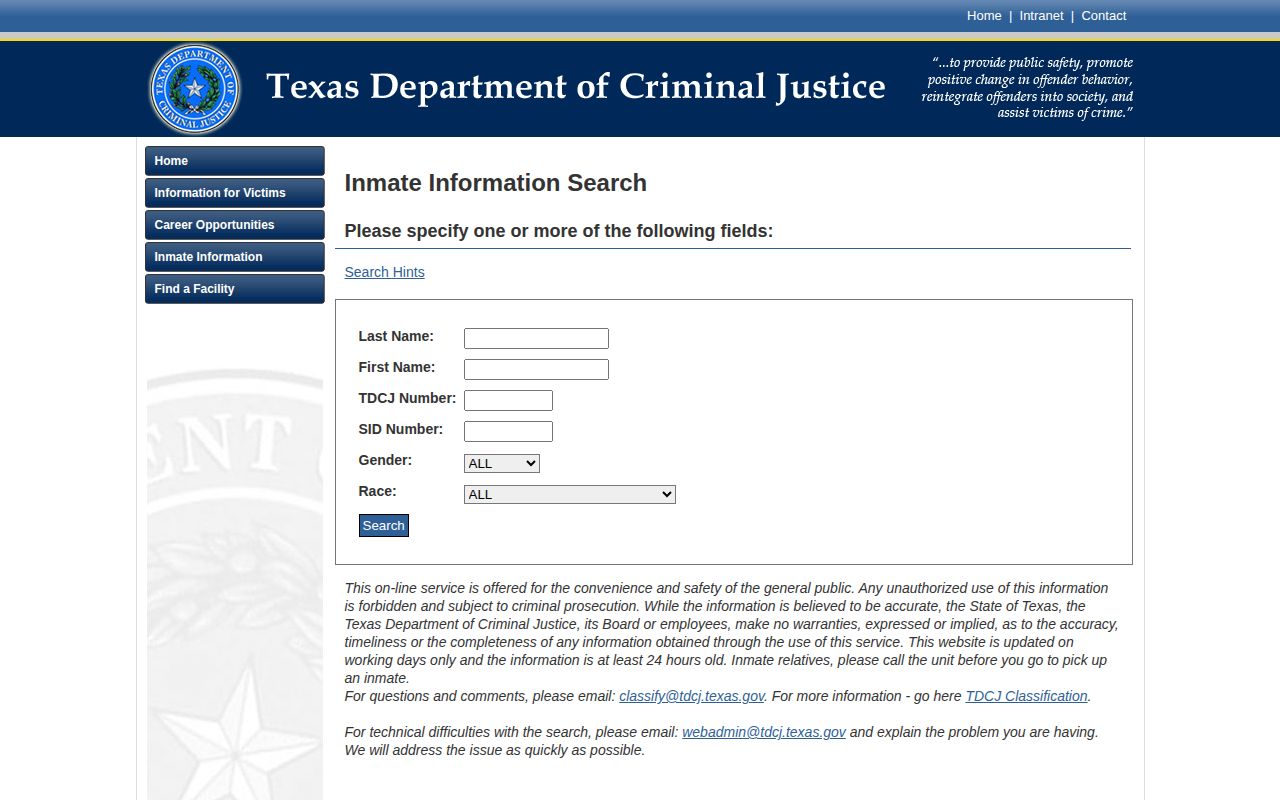
That limitation is why an old Zapata County release cannot be proved from a blank current TDCJ result.
Zapata Release Records by Court
Zapata County has a clear two-clerk path. The Constitutional County Court handles Class A and B misdemeanor matters, while the County Clerk keeps those records and links the LGS case search. The 49th District Court handles felony matters, and the District Clerk keeps its judgments and proceedings. Searching only one clerk can miss the event that explains why custody changed.
Look for bond set or posted, personal bond, dismissal, plea, judgment, sentence, jail-time credit, capias activity, commitment, or another order affecting custody. The docket explains legal authority. The jail register supplies the actual departure or transfer time. A bond release does not close the case, and failure to appear can lead to bond forfeiture and a capias.
Zapata Post-Release Supervision Checks
Parole and mandatory supervision follow a state-prison case. Zapata County maps to the TDCJ Parole Division’s Laredo District Parole Office, but an approved plan can affect the actual assignment. Probation is a court-ordered sentence administered locally by the Webb County Community Supervision and Corrections Department’s Zapata office. There is no public statewide probationer-name search identified in the research.
Verify parole through TDCJ and the assigned parole office. Verify probation in the filed judgment, then ask the CSCD office for procedural information it is permitted to provide. The Zapata County post-release supervision page gives the two distinct office routes and explains absconder and revocation terms.
Getting Home After Zapata Release
Zapata County advertises Zapata Express weekday bus service to Laredo, and a regional planning document discusses demand-response transportation. These facts establish a possible onward option, not a jail release service. No source confirms a jail-door stop, automatic eligibility, a guaranteed reservation, or transportation supplied by either jail.
First confirm which building will release the person and which exit or pickup point staff currently use. Then call Zapata Express at 956-765-9920 to check the schedule, reservation rules, eligibility, and a workable pickup location. Release processing can change, so a planned connection should not rely only on a projected time.
Zapata Release or Federal Transfer
Transfer checking matters in Zapata County. A July 2022 Texas Commission on Jail Standards report recorded 193 occupants at the 240-bed Regional Jail, including 162 contract occupants and 31 local occupants. An archived Justice Department table also records historical federal prisoner use. These dated sources do not prove a present contract or describe any current person. They show why a local booking can end through agency transfer.
For a sentenced federal prisoner, the BOP inmate locator may retain a release date or an outside-custody result. A U.S. Marshals pretrial transfer may not appear there, so the federal docket and Sheriff transfer record become important. The ICE Online Detainee Locator uses an A-number and country of birth or biographical details. A blank result does not prove release, removal, or departure from the United States.
Ask for the receiving agency by name. “No longer here” can mean release, transfer, treatment placement, hospital movement, or another custody change.
Zapata Release Notifications and Status
The Zapata County Sheriff links the Texas VINE system for public custody checks and notifications. Search by the person’s name or available offender identifier, compare the facility and identifying details, and read the exact status and event date. Registration options can include phone, text, email, or an account-based alert, depending on the live interface. A phone registration may require a private PIN to acknowledge calls and stop repeat attempts.
VINE is useful for a prompt signal, but it does not replace a certified record. An alert may follow the operational event, and an agency feed can lag. County VINE also should not be treated as the official TDCJ prison-discharge system. TDCJ Victim Services runs a separate post-conviction notification layer for eligible registrants in prison and parole matters. Federal BOP and immigration movements require their own channels.
If no VINE result appears, retry name variants and confirm the selected agency. Then call the facility. Ask for release versus transfer, not merely whether the person is “there.” The Sheriff record remains the best source for the local event, and the court document can show the order or judgment that led to it.
Zapata Released or Still in Custody
Each official system has a limited role. The county jail answers whether a local booking remains open. TDCJ’s online locator covers current state prisoners. BOP covers many current and former sentenced federal prisoners. Court dockets explain legal actions but do not track the moment a person walks out or transfers. Match the system to the custody type before interpreting the result.
| Source | Best use | What a blank result cannot prove |
|---|---|---|
| Zapata jail and VINE | Local custody event | Community release |
| TDCJ current search | Present state-prison status and projections | Full prior incarceration history |
| BOP locator | Federal sentenced-prison record | No federal pretrial custody |
| Court file | Bond, dismissal, judgment, or commitment | Physical departure time |
Zapata County Release Facilities
The county directory lists two distinct jail facilities. The Zapata County Regional Jail is at 2301 Kennedy and handles local and historically documented contract custody. The Zapata County Women’s Jail is separately listed at 7th Avenue and Hidalgo Boulevard. Current assignment rules are not published, so callers should not assume which building handled a booking.
Neither facility has an official public roster, recent-release archive, booking-photo gallery, or stated release schedule. Call the correct jail, use VINE, request the booking-out record, and match it to the court file. If another agency received the person, continue with that system instead of treating local disappearance as community release.